#1 Overall Winner
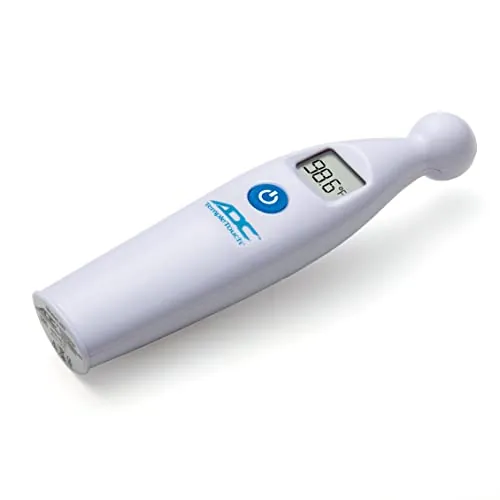
ADC Adtemp 427 Temple Touch Digital Thermometer
- Six-second temporal reading
Comparison
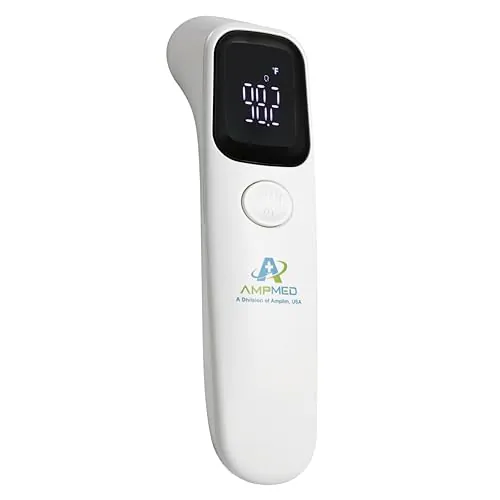
The ADC Adtemp 427 is stronger for compact portability, value, stated warranty coverage, and temporal-contact temperature checks. The Amplim is stronger for one-second, non-contact use, quiet nighttime checks, comfort, and ease of use. The key trade-off is a contact-based format with slightly stronger ownership scores versus a faster touch-free design with stronger convenience scores.
#1 Overall Winner
Contender
The ADC Adtemp 427 is the slightly stronger overall pick because it combines strong portability, value, durability, and a stated two-year warranty. The Amplim is better for users who want a one-second, quiet, no-touch forehead check, particularly around sleeping children. Both have mixed review feedback on consistency, so neither has a decisive accuracy advantage in the available data.
Overall winner
Depends on your needs
| Feature | ADC Adtemp 427 Temple Touch Digital Thermometer | Amplim No-Touch Infrared Forehead Thermometer | Winner |
|---|---|---|---|
| Overall score | 75 overall score | 74 overall score | ADC Adtemp 427 Temple Touch Digital Thermometer |
| Measurement approach | Temporal contact reading | Non-contact infrared forehead reading | Depends |
| Response time | 6 seconds | 1 second | Amplim No-Touch Infrared Forehead Thermometer |
| Health impact | Higher health-impact score | Lower health-impact score | ADC Adtemp 427 Temple Touch Digital Thermometer |
| Sleep support | Lower sleep-support score | Higher sleep-support score; quiet no-touch use | Amplim No-Touch Infrared Forehead Thermometer |
| Tracking accuracy | 67 tracking-accuracy score | 66 tracking-accuracy score | ADC Adtemp 427 Temple Touch Digital Thermometer |
| Data and memory | Last-reading memory; low data-insight score | Memory recall; higher data-insight score | Amplim No-Touch Infrared Forehead Thermometer |
| Comfort | 82 comfort score | 88 comfort score | Amplim No-Touch Infrared Forehead Thermometer |
| Ease of use | 85 ease-of-use score | 92 ease-of-use score | Amplim No-Touch Infrared Forehead Thermometer |
| Safety | 67 safety score | 83 safety score | Amplim No-Touch Infrared Forehead Thermometer |
| Durability | 73 durability score | 68 durability score | ADC Adtemp 427 Temple Touch Digital Thermometer |
| Maintenance | 86 maintenance score | 86 maintenance score | Tie |
| Portability | 94 portability score | 89 portability score | ADC Adtemp 427 Temple Touch Digital Thermometer |
| Value | 85 value score; listed at 15.55 | 84 value score; listed at 26.58 | ADC Adtemp 427 Temple Touch Digital Thermometer |
| Warranty and support | Two-year warranty; 78 support score | One-year warranty card; 62 support score | ADC Adtemp 427 Temple Touch Digital Thermometer |
Both products support basic at-home temperature awareness rather than diagnosis or treatment. The ADC has the higher health-impact score, reflecting its temporal-contact format, stated ASTM compliance, and use as a compact home thermometer. The Amplim remains a practical health-monitoring option because its no-touch approach can make frequent checks easier, especially for children and sleeping users. Neither product provides ongoing health tracking, interpretation beyond the displayed result, or clinical decision-making support. Mixed review feedback on accuracy consistency for both means users should follow the instructions and use appropriate judgment if a reading seems inconsistent with the situation.
Neither device is a fitness tracker, workout monitor, or performance tool. The ADC has a modestly higher fitness-support score, but this reflects limited utility for occasional temperature awareness rather than exercise metrics, activity tracking, or training guidance. The Amplim has no meaningful fitness-support score in the supplied data. For users seeking heart-rate, workout, recovery, or activity data, neither thermometer is designed to provide those functions.
The Amplim is the better fit for temperature checks around sleep. Its non-contact infrared design, stated quiet operation, one-second response, and higher sleep-support score can reduce the practical disruption of checking a sleeping child. The ADC can also be used when a patient is sleeping according to its description, but it requires temple contact and takes six seconds. Neither device is a sleep tracker or sleep-improvement product; the comparison is limited to the convenience of temperature checks during nighttime care.
Neither thermometer directly supports muscle recovery, readiness scoring, or post-workout treatment. The Amplim has the higher recovery-support score, largely as a convenient touch-free option for an occasional temperature check, while the ADC offers a more traditional temporal-contact alternative. This difference should not be read as evidence that either product improves recovery. Their role is limited to taking temperature readings, and neither provides recovery trends, coaching, or physical recovery functions in the supplied details.
The Amplim has a modest wellness-support lead because its quick, no-touch operation, bright display, and memory recall may make routine home checks more convenient. The ADC also supports simple household wellness routines through compact storage, fast readings, memory, and easy cleaning. Neither product offers broader wellness programs, mindfulness tools, or personalized lifestyle guidance. Their relevance to wellness is practical: they can help users keep a thermometer available for basic at-home monitoring.
The ADC has a narrow effectiveness-score lead. It is designed for temporal-contact readings and states that it meets ASTM E1112 accuracy requirements for intermittent thermometers. Customers frequently praise its quick operation, ease of use, and value, although some report inconsistent readings, especially when taking repeated measurements or using it with children. The Amplim has a nearly equal effectiveness score and offers a much faster stated one-second no-touch reading. Its reviews also contain praise for speed and usability, alongside reports of variable results. The available data supports a narrow ADC lead, not a definitive reliability advantage.
Neither thermometer directly supports muscle recovery, readiness scoring, or post-workout treatment. The Amplim has the higher recovery-support score, largely as a convenient touch-free option for an occasional temperature check, while the ADC offers a more traditional temporal-contact alternative. This difference should not be read as evidence that either product improves recovery. Their role is limited to taking temperature readings, and neither provides recovery trends, coaching, or physical recovery functions in the supplied details.
The Amplim has the higher evidence-quality score, but the supplied material is mainly product listing information and customer feedback rather than independent clinical evidence. The ADC provides a more specific standards-related statement, saying it meets ASTM E1112 accuracy requirements for intermittent thermometers. The Amplim is listed as approved, but no further approval detail is supplied. Customer reviews can describe real-world handling and perceived consistency, but they cannot establish clinical accuracy. For both products, the evidence supports their basic thermometer function while leaving uncertainty because review feedback on measurement consistency is mixed.
The Amplim has the stronger safety score. Its non-contact forehead measurement is designed to reduce cross-contact, which may be convenient when checking multiple family members. The ADC also aims to reduce cross contamination and does not require probe covers, but its intended method involves temple contact. Both are battery-powered plastic devices for indoor use, so sensible handling, cleaning according to the instructions, and attention to the stated measurement method are relevant. The supplied data does not establish either thermometer as a diagnostic device, and inconsistent or concerning readings should not be interpreted beyond the product instructions.
The Amplim leads on comfort, primarily because its infrared forehead measurement does not require skin contact and is described as quiet. This is a useful advantage for infants, children, or anyone who dislikes a device held at the temple. The ADC still earns a strong comfort score: it is small, lightweight, and designed for a brief temporal-contact reading. However, customer feedback suggests contact placement can be less straightforward with a wiggly baby. The practical preference is clear: touch-free convenience favors the Amplim, while the ADC suits users comfortable with a brief temple hold.
The Amplim has the higher ease-of-use score. Its stated one-second response, no-touch format, LED display, fever alert, memory recall, and Fahrenheit/Celsius switch are designed for fast, straightforward checks. Reviewers often mention the readable display and simple operation, although one review describes confusing mode and unit changes. The ADC is also highly rated for usability, with a large display, audible tone, auto-off, and six-second results. Its contact placement requires a little more technique, and several reviews recommend practicing before relying on it in a stressful moment.
The two products are tied on build-quality score and both use plastic housings with digital displays. The ADC’s compact format is described as lightweight and water resistant, and reviews commonly call it practical for home use. The Amplim is described by some reviewers as well made and easy to hold, with a bright LED screen. Neither product has a clear build-quality lead from the score data. The ADC’s stronger warranty support may be reassuring for ownership, while the Amplim’s touch-free shape may be easier to handle for some users.
The ADC has the higher durability score. Its listing states a long battery life, and one reviewer reported that a unit purchased years earlier was still working well, although that is an individual experience rather than a guarantee. The Amplim has a lower durability score, and the supplied reviews include a concern about an older manufacturing batch. Both products are designed for intermittent home use, but long-term reliability can vary by unit. The ADC has the stronger available signal for users prioritizing durability and stated ownership coverage.
Maintenance is a tie: both receive the same high maintenance score, are reusable, and use included batteries. The ADC is listed as hand-wash only and is described by reviewers as easy to clean, while the Amplim is listed as wipe clean. The main practical difference is measurement method: the Amplim avoids direct forehead contact, whereas the ADC’s temple-contact surface needs appropriate cleaning between users.
The ADC leads for portability. Its listed dimensions and very low stated weight support easy storage in a medicine cabinet, bag, or pocket. The Amplim is also compact, with a listed length of 4.69 inches and home-and-travel positioning. Choose the ADC for the stronger portability score; choose the Amplim if touch-free convenience matters more than the small score difference.
The ADC holds a one-point lead in tracking-accuracy score, but the available data does not establish a large practical gap. The ADC’s description includes an ASTM E1112 compliance statement, while some customers report accurate, repeatable readings and others report substantial variation. The Amplim is similarly mixed: reviewers praise correct or consistent results when used at the stated distance, while others report readings that vary under similar conditions. Neither product should be described as medical-grade based on the supplied information. Follow each product’s measurement instructions, and treat unexpected results cautiously.
The Amplim has the stronger data-insight score because it includes memory recall intended to help users review previous readings. The ADC has last-reading memory, which is more limited as a basic reference feature. Neither device offers an app, dashboards, trend analysis, personalized recommendations, or connected reporting. For users who only need to compare a recent reading, either memory function may be useful. For users wanting longer-term temperature records or health analytics, the supplied data indicates that neither product is a robust data-focused option.
The products are tied on personalization score. Both offer dual temperature units, allowing users to choose Fahrenheit or Celsius. The ADC adds basic operating conveniences such as auto-off and an audible completion tone, while the Amplim adds a fever alert and memory recall. Neither listing describes user profiles, custom thresholds, app settings, adjustable measurement modes beyond the stated functions, or personalized guidance. Personalization is therefore limited to basic display and operating preferences rather than tailored health monitoring.
The ADC has a narrow value-score advantage and a lower listed price of 15.55 versus 26.58 for the Amplim. It also offers a stated two-year warranty, strong portability, and an ASTM-related accuracy compliance statement. The Amplim justifies part of its higher price through its one-second no-touch format, quiet use, LED display, fever alert, and stronger ease-of-use and satisfaction scores. Neither is automatically better value for every household. The ADC is the stronger budget-oriented choice, while the Amplim may be worth the extra cost for users who prioritize touch-free speed and nighttime convenience.
The ADC has the higher brand-trust score. The available product details identify American Diagnostic Corp as the manufacturer, provide a model and standards-related statement, and specify a two-year warranty. The Amplim has a lower brand-trust score but a large review base and generally high customer satisfaction. Its listing includes a one-year warranty card, although the supplied data provides less support detail. This comparison does not establish brand-wide quality; it only indicates that the ADC has the stronger trust signal in the provided product and scoring data.
The Amplim leads on customer satisfaction, with an 88 score, a 4.5/5 average rating, and 22,673 reviews. Recurring praise covers speed, display visibility, ease of use, and touch-free convenience. The ADC’s 79 satisfaction score, 4.3/5 rating, and 13,406 reviews still represent substantial positive feedback, particularly for practicality, fast readings, and value. The important caution is that both products have mixed accuracy feedback. Some customers report dependable results, while others describe inconsistent measurements. Ratings and reviews help describe user experience but do not prove measurement accuracy for every unit or situation.
The ADC is the clearer winner for warranty support. Its details state a two-year warranty and it receives the higher warranty-support score. The Amplim package includes a one-year warranty card, but its warranty-support score is lower and the supplied information gives fewer details about support processes. For buyers who want more explicit coverage from the provided data, the ADC is the safer choice. Warranty terms should still be checked at purchase because listing details can change.
The ADC Adtemp 427 wins by a small overall margin, supported by stronger scores for portability, durability, value, brand trust, and warranty support. The Amplim is the more convenient family-oriented alternative, with a one-second no-touch reading and clear advantages in comfort, ease of use, sleep-related convenience, safety score, and customer satisfaction. The decision comes down to whether you value contact-based temporal measurement and ownership value, or touch-free speed and convenience. Neither product has a decisive accuracy lead in the supplied review and score data.
Overall winner
Depends on your needs
The ADC Adtemp 427 has the slightly higher overall score and stronger scores for portability, durability, value, brand trust, and warranty support. The Amplim is stronger for one-second no-contact operation, ease of use, comfort, safety, and customer satisfaction. The better choice depends mainly on whether you prefer contact measurement or a faster touch-free check.
The Amplim is the more suitable option for this use based on the available data. Its non-contact design, quiet operation, one-second response time, and higher sleep-support score make it more convenient for a quick nighttime check without direct contact. As with either device, mixed review feedback on consistency means an unexpected result should be treated carefully.
The Amplim has the higher ease-of-use score. Its stated one-second reading, no-touch operation, LED display, and fever-alert features support a simpler quick-check experience. The ADC is also rated highly for usability and includes a large display, audible completion tone, and auto-off, but requires placement at the temple for its reading.
The Amplim has the higher customer-satisfaction score, a 4.5/5 average rating, and 22,673 reviews. The ADC has a 4.3/5 average from 13,406 reviews and is frequently praised for speed, simplicity, and value. Both review sets include reports of inconsistent readings, so positive customer feedback should not be treated as proof of accuracy in every use.
The ADC is the better travel-oriented choice by score, with a higher portability rating and a stated lightweight, compact design. The Amplim is also compact and suitable for home and travel according to its listing. Choose the ADC for its stronger portability and warranty scores, or the Amplim if touch-free one-second checks are the higher priority.
The ADC narrowly leads on value score and has the lower listed price. It also includes a stated two-year warranty and earns strong marks for portability and maintenance. The Amplim costs more but adds no-touch infrared operation, a one-second response, quiet use, and a fever alert. Value therefore depends on whether those convenience features matter to you.
No. The ADC states that it meets ASTM E1112 accuracy requirements for intermittent thermometers, while the Amplim is described as approved in the supplied details. However, customer reviews for both products are mixed on consistency. Reviews are individual experiences rather than clinical validation, and neither product should be assumed to provide medical-grade accuracy from the supplied data alone.
The ADC is stronger for warranty support. Its product details state a two-year warranty, and it has the higher warranty-support score. The Amplim includes a one-year warranty card in the listed package contents, but its lower warranty-support score and one review about an older manufacturing batch create more uncertainty around long-term ownership support.
Check our rankings and expert guides to find the best health products for your goals.